
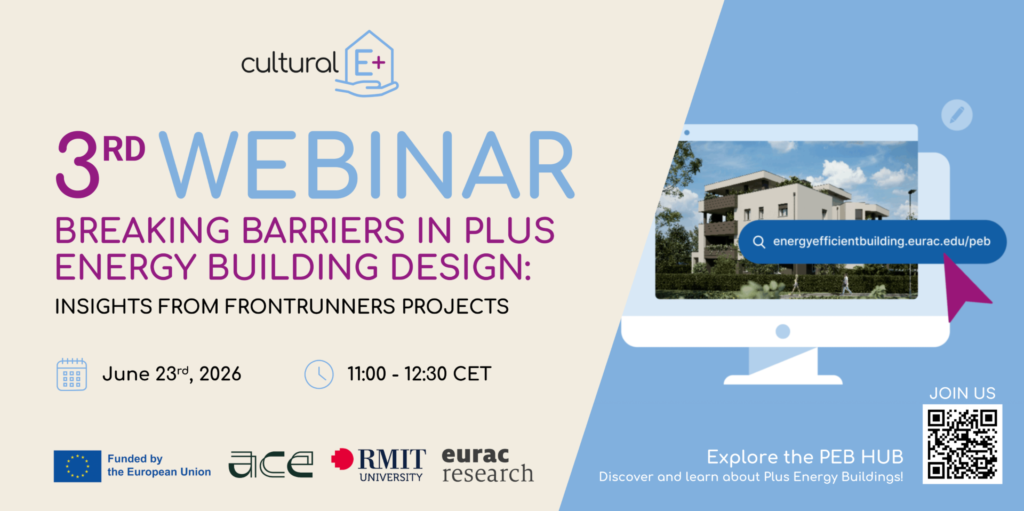
Join the webinar on “Breaking Barriers in Plus Energy Building Design: Insights from frontrunners projects”
What does it take to design a single-family house that generates more energy than it consumes, without compromising on architecture?
In this webinar, we show real projects pushing the boundaries of Plus Energy Building (PEB) design across Europe. You’ll hear directly from the designers behind them: what worked, what didn’t, and what every designer should know before taking on a PEB project.
We’ll also introduce the PEB HUB: this is a growing repository of Plus Energy Building projects and a professional community where architects and engineers share practical know-how. It is built to support professionals like you in making plus energy design the standard, not the exception.
During the session, you will also explore the PEB Interest Group on the ACE HUB app, a dedicated space to connect with peers, exchange insights, and stay up to date on PEB practice across Europe.
The webinar will take place on June 23rd from 11:00 to 12:30 (CET)
Agenda:
11:00 – 11:05 – Welcome introduction
11:05 – 11:15 – Presentation of the different sections in the PEB HUB: a walkthrough of the platform through the platform. Technical aspects and designers’ guidelines, including socio-cultural aspects.
11:15 – 11:20 – Presentation of PEB Interest Group at ACE HUB, designers’ online community to share information on Plus Energy Buildings.
11:20 – 11:45 – Panel discussion: 2 PEB HUB members will address the following questions:
- What are the main challenges in designing a PEB?
- How can the PEB HUB support different PEB professionals?
PEB Case 1: Woonhuis Hertoglaan ‘s-Hertogenbosch, Netherlands
Presenter: Hugo de Vries, Zenzo MV
PEB Case 2: TR80 – Single Family House in Barcelona, Spain
Presenter: David Masip Vila’, Batlleiroig
11:50 – 12:00 – Q&A and open discussion
If you missed our previous webinar, watch the recording here and join our community!
The PEB HUB is developed through the Horizon 2020 Cultural-E project, led by Eurac Research in collaboration with RMIT Europe and promoted by the Architects’ Council of Europe.